Skewed Normal Distribution | ||||
|
| |||
The skewed normal distribution is defined by three parameters (Owen, 1956):
-
skewness ,
-
strictly positive scale , and
-
location .
A normal distribution is obtained when the skewness is zero (i.e., ). The direction in which the distribution is skewed depends on the sign of .
The skewed normal cumulative distribution function is
where is the Owen’s T-function:
The mean and standard deviations for the skewed normal distribution are
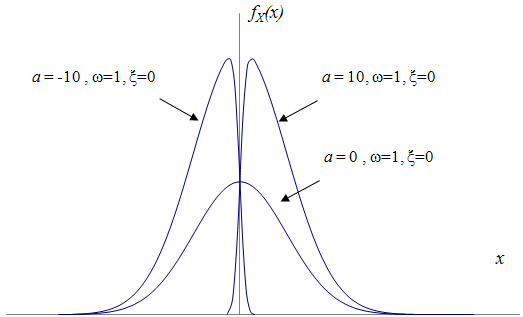
The skewed normal probability density function, is
where is the standard normal probability density function and is the standard normal cumulative distribution function.
The figure below illustrates the skewed normal probability density function,